
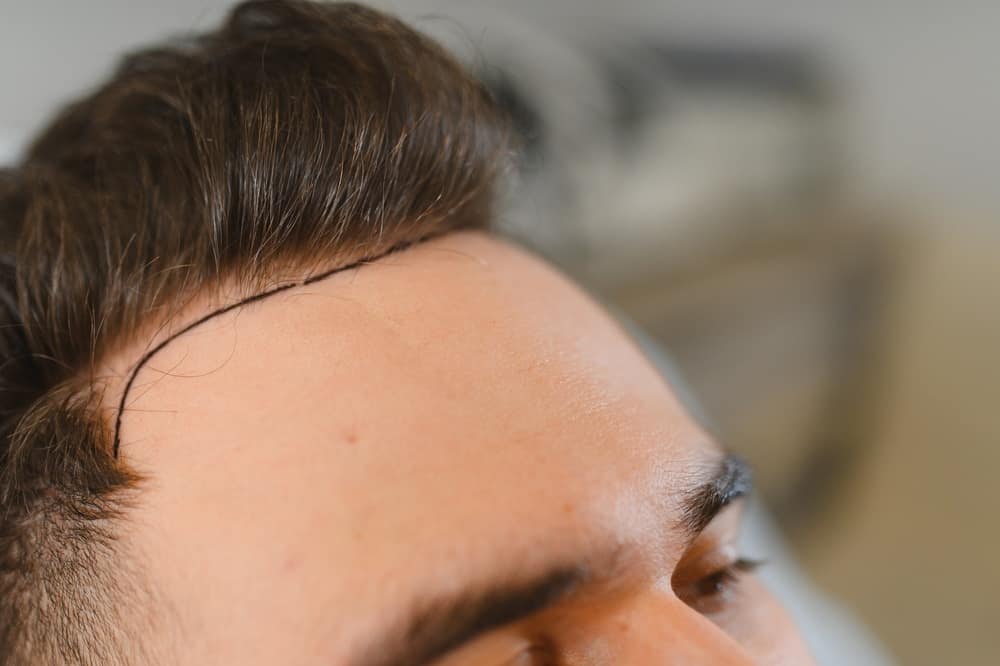
Not every hairline concern is about hair loss. Some people have simply always had a high hairline, one that creates a large expanse of forehead regardless of how full their hair is. For these patients, the solution isn’t necessarily a hair transplant. It may be a hairline lowering procedure.
Dr. Bruce Marko at RESTORE Hair works with patients across a range of hairline concerns, and understanding which approach fits which situation is the foundation of good treatment planning.
Disclaimer: This content is provided for informational purposes only and is not intended to serve as professional health advice. Individual care recommendations may vary. Always consult with your doctor for personalized guidance regarding your health or treatment.
What Is a Hairline Lowering Procedure?
A hairline lowering procedure, also called a forehead reduction, is a surgical technique that physically advances the hairline forward to reduce the height of the forehead. Unlike a hair transplant, which moves follicles from a donor area to a thinning zone, hairline lowering repositions the existing hairline itself.
The procedure involves making an incision along the natural hairline, removing a strip of forehead skin, and advancing the hair-bearing scalp forward. The result is an immediately lower hairline with no waiting period for growth. Because the existing hair moves with the scalp, density is preserved from day one.
How It Differs from a Hair Transplant
The two procedures address different problems and suit different patients.
A hair transplant is the appropriate approach when hair loss or thinning is the underlying issue. Follicles are relocated to restore density where it has been lost, and results develop gradually over twelve to eighteen months.
Hairline lowering is for patients who have a naturally high hairline with no significant thinning. The hair itself is healthy and dense. The issue is purely positional. Because no follicle relocation is involved, results are immediate rather than gradual.
In some situations, a combination approach makes sense. A hairline lowering procedure advances the central hairline, while transplants refine the temples or address any areas of thinning alongside it.
Who Is a Good Candidate?
The right candidate for hairline lowering has a few key characteristics.
Good scalp laxity is essential. The forehead skin needs sufficient flexibility to allow the hairline to advance without excessive tension on the incision. A surgeon will assess this during consultation.
The candidate should have a naturally high hairline rather than one caused by progressive hair loss. This distinction matters because hairline lowering doesn’t address ongoing loss. A patient whose hairline is receding due to androgenetic alopecia may see continued recession after the procedure, which complicates the result.
A stable hair loss pattern, or no hair loss at all, makes for a more predictable and lasting outcome.
What About Scarring?
The incision is placed directly along the hairline, where the scar is concealed by the hair in front of it. For most patients, scarring is minimal and well hidden once healed. Surgeons with experience in hairline work place incisions carefully to follow the natural contour of the hairline, which further minimizes visibility.
Is It the Right Option for You?
If a high forehead has always been a concern and your hair itself is healthy and full, hairline lowering is worth exploring. If thinning or recession is part of the picture, a transplant or combination approach may be more appropriate.
Dr. Bruce Marko offers thorough consultations to help patients identify the right path for their specific situation. Reach out to RESTORE Hair today to schedule yours.
Leave a Reply