
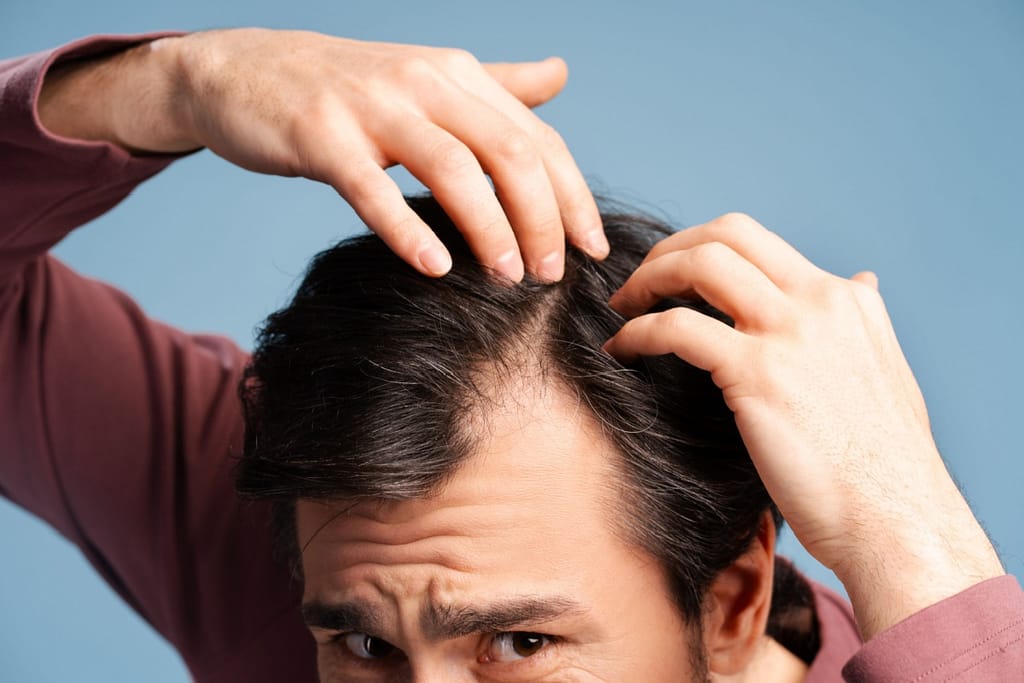
You’re in the shower. You glance down. There’s more hair circling the drain than you remember seeing last week, or maybe last month. You do a quick mental calculation, try to remember if this is new, and then spend the next ten minutes quietly spiraling.
Sound familiar?
Most people have been there. And most people have absolutely no idea whether what they’re looking at is completely normal or calls for attention. The line between everyday shedding and genuine hair loss is blurrier than you’d think, and the internet, bless it, is not particularly helpful when you’re standing in a towel trying to figure it out.
That’s what this is for. Dr. Bruce Marko at RESTORE Hair works with patients navigating exactly this confusion, and the first step toward any meaningful answer is understanding what’s actually happening with your hair in the first place.
Disclaimer: This content is provided for informational purposes only and is not intended to serve as professional health advice. Individual care recommendations may vary. Always consult with your doctor for individualized advice regarding your health or treatment.
Your Hair Is Always Doing Something
Your hair is never just sitting there. Every single follicle on your scalp is cycling through a continuous process of growth, transition, and rest, on its own independent schedule.
The active growth phase, called anagen, can last from 2 to 7 years. After that, the follicle enters a brief transitional phase before entering telogen, the resting phase, where the hair essentially hangs on before shedding, making room for new growth.
Roughly 85 to 90 percent of your hair is actively growing at any given time. The remaining 10 to 15 percent is resting and preparing to shed. So when hair falls out, that’s not damage. That’s the system working exactly as it should.
Most people can expect to shed 50 to 100 hairs per day. That sounds like a lot, but remember that your scalp has about 100,000 hairs.
So What’s the Difference, Actually?
This is the part people get tangled up in, understandably.
Shedding is the natural, cyclical letting go of hairs that have completed their growth cycle. The follicle itself is fine. It will rest briefly and then produce a new hair strand. The process repeats. Nothing is being lost permanently.
Hair loss is different. It happens when the follicle itself is damaged, interrupting the hair growth cycle. Instead of resting and regeneration, the follicle shrinks, weakens, or even stops producing hair completely.
Essentially, shedding is temporary and cyclical, while hair loss involves the follicle itself. Without intervention, it tends to be progressive.
What Normal Shedding Looks Like
Normal shedding is pretty democratic. It shows up everywhere with no particular pattern or preference. You’ll find it on your pillow, in your hairbrush, on the bathroom floor, clinging to the back of your shirt. Diffuse, spread out, not concentrated in any one area.
It often increases around certain triggers. Seasonal shifts, particularly in autumn, can push more follicles into the resting phase simultaneously, which means more shedding for a few weeks. Significant physical or emotional stress can do the same thing. So can hormonal changes like those following pregnancy, where a flood of hair that stayed put during those nine months suddenly lets go all at once, a few months postpartum. Rapid weight shifts, as covered in a previous post on this blog, can trigger a similar response.
The important thing to keep in mind is that normal shedding resolves. After the trigger passes, the hair cycle resumes its regular cycle.
What Hair Loss Actually Looks Like
True hair loss looks different. It has a pattern, a location, and a direction it tends to move.
For most people with androgenetic alopecia, the most common form, symptoms include a gradually receding hairline, thinning at the crown, or a part that seems to be getting wider over time. It’s not evenly distributed across the scalp. It concentrates in specific zones and, without treatment, continues progressing in those same areas.
Alopecia areata presents differently: smooth, roughly circular patches where hair is simply absent. No gradual thinning, just a distinct bald spot that can appear seemingly out of nowhere.
Traction alopecia, which develops from repeated tension on the follicles, typically shows up along the hairline and temples, often with some redness or tenderness in the early stages.
The unifying thread across all of these is that the hair doesn’t cycle back. Weeks pass, then months, and the affected areas remain thin or bare rather than filling in as they would after a normal shedding episode.
The Warning Signs Worth Taking Seriously
There’s a difference between noticing more hair than usual for a couple of weeks and watching a pattern develop over months. The former is often nothing. The latter deserves a closer look.
Here’s what to pay attention to:
- Shedding that continues for more than 3-4 months without any obvious triggers or resolution. Typically, stress-related shedding improves once the underlying cause has passed.
- Localized thinning, rather than diffuse loss. Hair loss around the crown, temples, or hairline may be a sign of male pattern baldness.
- Scalp changes, like persistent redness, tenderness, flaking, or small bumps around the follicles—this can indicate inflammation or a scalp issue.
- A visibly wider part. This is a big sign of progressive hair loss, particularly in women.
- Hair that’s breaking rather than shedding from the root. This is another issue, related to the condition and integrity of the hair shaft rather than follicle health, but it’s worth distinguishing because the causes and solutions differ.
Common Causes of Each
It helps to know what’s typically driving each situation.
Normal shedding that’s temporarily elevated is most often associated with telogen effluvium, a condition in which a larger-than-usual proportion of hairs shift into the resting phase at once in response to physical or emotional stress. Illness, surgery, extreme dietary restriction, hormone variations, and life stressors might all trigger it. It’s the body transferring resources, and it’s almost always reversible.
True hair loss has a different set of drivers:
- Androgenetic alopecia, the genetic sensitivity to DHT discussed in the previous post on receding hairlines, is the most prevalent.
- Alopecia areata is an autoimmune condition in which the body attacks hair follicles.
- Traction alopecia results from prolonged mechanical stress on the follicles.
- Nutritional deficiencies, particularly in iron, vitamin D, zinc, and protein, can also tip the balance from temporary shedding to a longer-lasting condition that requires more deliberate correction.
The distinction matters because the treatment pathway is entirely different depending on what’s actually happening.
When to Stop Googling and See Someone
Honestly? If you’re reading this and something is nagging at you, that’s probably reason enough to get a professional opinion. Not because it’s necessarily serious, but because an evaluation takes the guesswork out of it entirely.
Here are the signs you should seek a professional’s opinion:
- Shedding that hasn’t improved after 3-4 months.
- Visible thinning or pattern changes that weren’t there six months ago.
- A family history of significant hair loss and early signs that seem to be following the same trajectory.
- Any sudden, patchy hair loss.
- Scalp symptoms that aren’t resolving on their own.
Dr. Bruce Marko offers thorough evaluations at RESTORE Hair that look at the full picture, not just what’s visible on the surface. Determining whether you’re dealing with temporary shedding or something that needs targeted treatment makes an enormous difference in what comes next, and getting that clarity early almost always results in better outcomes.
Knowing the Difference Is Half the Battle
Most hair concerns, when caught and addressed early, are highly manageable. The frustrating part is that people often wait far longer than necessary because they’re not sure whether what they’re experiencing is worth mentioning.
It is. You don’t need to have a dramatic amount of hair loss to deserve a straight answer about what’s going on with your scalp.
Whether what you’re seeing turns out to be perfectly normal shedding that will sort itself out, or an early sign of something that benefits from treatment, knowing which one you’re dealing with puts you back in control. And that’s genuinely worth something.
If you’ve been watching your hair and wondering, contact RESTORE Hair and schedule a consultation with Dr. Bruce Marko. A clear answer is closer than you think.
Leave a Reply